
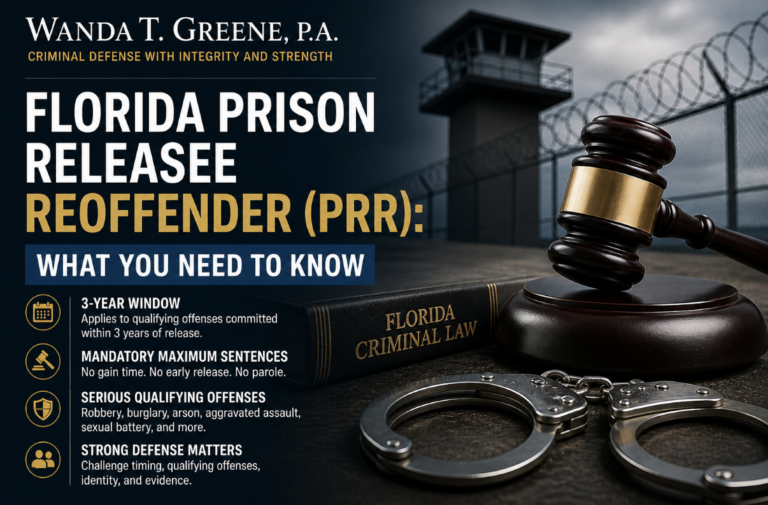
Florida’s Prison Releasee Reoffender (PRR) law is one of the harshest sentencing laws in the state. It requires mandatory, maximum prison sentences for individuals accused of committing certain crimes shortly after being released from prison and unlike standard sentencing, judges have no discretion when PRR applies.
If you are facing possible Florida Prison Releasee Reoffender designation, you need to understand what is at stake immediately.
What Is a Florida Prison Releasee Reoffender (PRR)?
A Florida Prison Releasee Reoffender (PRR) is someone accused of committing a qualifying offense within three years of being released from prison.
If PRR applies, the Court must impose the maximum sentence allowed by law.
When Does the PRR Law Apply?
The Florida Prison Releasee Reoffender law applies to someone who:
-
Is released from a state prison, and
-
Commits or attempts to commit a qualifying offense within 3 years of release
The 3-year period includes release from:
-
State prison
-
Private correctional facilities
-
Out-of-state or federal institutions (in some cases)
What Crimes Qualify Under PRR?
Not every charge triggers PRR sentencing. The law applies to specific serious offenses, including:
-
Robbery
-
Burglary of a dwelling or structure
-
Arson
-
Kidnapping
-
Aggravated assault or battery
-
Sexual battery
-
Carjacking
-
Home invasion robbery
-
Murder or manslaughter
Even attempts or conspiracies to commit these crimes may qualify.
Mandatory Sentences Under PRR
If the court classifies someone as a PRR, the Court must impose the maximum sentence allowed by law, including:
-
Life felony or capital felony: Life imprisonment
-
First-degree felony: 30 years imprisonment
-
Second-degree felony: 15 years imprisonment
-
Third-degree felony: 5 years imprisonment
🚨 Important: These sentences must be served day-for-day. There is:
-
No gain time
-
No early release
-
No parole
Why PRR Cases Are So Serious
PRR designation dramatically raises the stakes:
-
No plea bargaining leverage in many cases
-
No downward departure by the judge
-
Immediate exposure to lengthy prison terms
Prosecutors often pursue PRR aggressively, especially in repeat-offense situations.
Possible Defenses to PRR Classification
Just because the State files PRR does not mean it automatically applies. A strong defense may challenge:
1. Timing Issues
Was the alleged offense truly within the 3-year window?
2. Qualifying Offense
Does the charge actually meet PRR criteria?
3. Identity or Evidence
Can the State prove the new offense beyond a reasonable doubt?
4. Release Status
Was the prior release from a qualifying custodial sentence?
Even small factual differences can make a major impact.
Can a Prosecutor Decline to seek a PRR Sentence?
Yes. While the law is strict, prosecutors have discretion to waive PRR sentencing in certain cases.
This is where experienced legal representation matters most—early intervention can influence how the case is charged and prosecuted.
What To Do If You’re Facing PRR Charges
If you or a loved one is facing a potential PRR designation:
-
Act immediately
-
Do not speak to law enforcement without counsel
-
Gather documentation regarding prior release dates
-
Hire an experienced criminal defense attorney as early as possible
Time is critical in these cases.
Final Thoughts
Florida’s Prison Releasee Reoffender law is designed to impose harsh, mandatory punishment on repeat offenders—but it is not automatic. The details matter, and a strategic defense can make a difference.
Need Help With a PRR Case?
At Wanda T. Greene, P.A., we provide Criminal Defense with Integrity and Strength. If you’re facing serious felony charges or a potential PRR designation, early and aggressive representation is essential.