
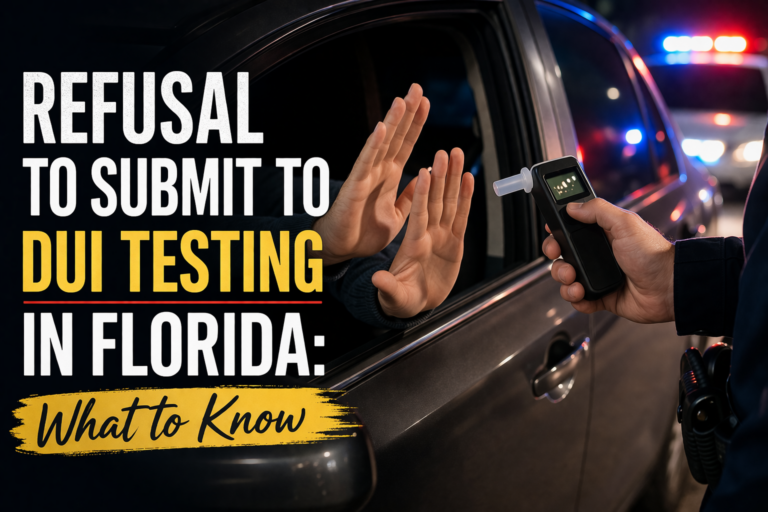
Following a DUI arrest, if a Florida police officer asks you to take a breath or urine test, you face an important decision. Refusal to submit to DUI testing in Florida is a criminal offense and can trigger immediate penalties – even if you are never convicted of DUI.
Florida law treats refusals seriously. Here’s what you need to know before making that decision.
What is “Implied Consent” in Florida?
Under Florida’s implied consent law, any person who drives in the state automatically agrees to submit to lawful chemical testing if an officer suspects DUI.
This law appears in Florida Statute 316.1932.
That means:
- You do not have the right to “just say no” without serious consequences
- Refusal is a criminal offense and can lead to criminal penalties
What Happens if I Refuse Testing?
Refusal is a criminal offense punishable as follows:
-
First Refusal:
- Second degree misdemeanor
- Up to 60 days in jail or 6 months of probation
- Fine up to $500
- 1 year license suspension
-
Second or Subsequent Refusal:
- First Degree Misdemeanor
- Up to 12 months in jail or 12 months of probation
- Fine up to $1,000
- 18 month license suspension
Defending Refusal Charges
An experienced defense attorney may challenge a refusal by examining:
Whether the Stop was Lawful
If the officer lacked legal justification to stop you, the entire case may be challenged.
Whether You Were Properly Warned
Officers must inform you of the consequences of refusal. Failure to do so can be a strong defense.
Whether You Actually Refused
Confusion, language barriers, or unclear communication can raise doubt about whether a true refusal occurred.
Final Thoughts
Time is of the essence. If you’ve been arrested for DUI and Refusal, don’t wait. Get an experienced attorney to aggressively defend your rights. Wanda T. Greene has represented thousands of clients and is ready to fight for you with integrity and strength.