
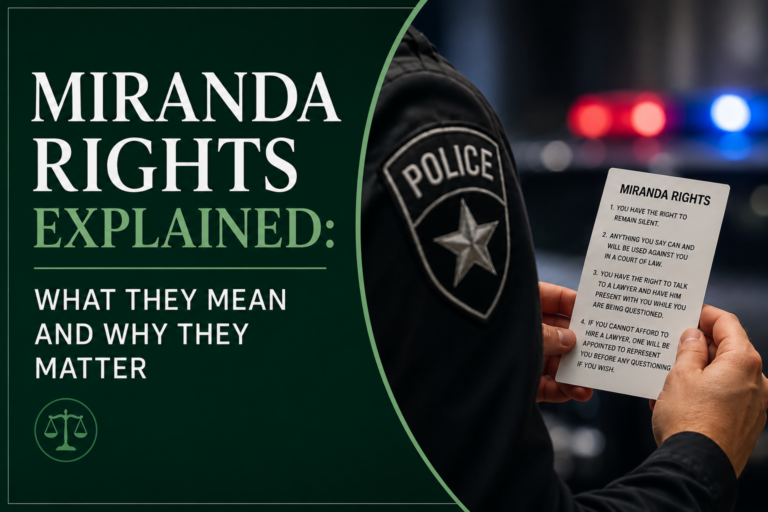
Miranda Rights Explained: What They Mean and Why They Matter
If you have ever watched a police show, you have probably heard the phrase:
“You have the right to remain silent…”
These protections are known as Miranda Rights, and they play a major role in criminal defense cases throughout the United States. Understanding these rights can help you protect yourself during police interactions and avoid making statements that could later be used against you.
What Are Miranda Rights?
Miranda Rights are warnings law enforcement officers must provide before conducting a custodial interrogation. These warnings inform a person of their constitutional rights under the Fifth and Sixth Amendments. The rights were established by the landmark United States Supreme Court case Miranda v. Arizona.
The standard Miranda warning generally includes:
- The right to remain silent
- Anything said can be used against the person in court
- The right to an attorney
- The right to have an attorney appointed if the person cannot afford one
Where Did Miranda Rights Come From?
Miranda Rights originated from the 1966 Supreme Court decision in Miranda v. Arizona. In that case, Ernesto Miranda confessed to crimes after police questioning without being informed of his constitutional rights. The Supreme Court ruled that statements obtained during custodial interrogation are generally inadmissible unless the suspect was first advised of their rights.
The Court recognized that police interrogations can be inherently coercive and that individuals must be informed of their rights before questioning begins.
When Do Police Have to Read Miranda Rights?
Many people mistakenly believe police must read Miranda Rights immediately upon arrest. That is not always true.
Miranda warnings are generally required only when BOTH of the following apply:
- The person is in custody, and
- Law enforcement is conducting an interrogation
If a person is not in custody or is not being interrogated, Miranda warnings may not be required.
What Counts as “Custody”?
Custody usually means a reasonable person would not feel free to leave. Examples may include:
- Being formally arrested
- Being handcuffed
- Being placed in a police car
- Being questioned in a police interrogation room
However, whether someone was truly “in custody” can become a major legal issue in criminal cases.
What Happens If Police Fail to Read Miranda Rights?
If police question a person in custody without giving Miranda warnings, statements obtained during that interrogation may be suppressed and excluded from evidence in court.
That does NOT necessarily mean the case will be dismissed. Prosecutors may still attempt to use:
- Physical evidence
- Witness testimony
- Independent evidence unrelated to the statement
Still, suppressing a confession or incriminating statement can significantly impact the prosecution’s case.
Can Someone Waive Miranda Rights?
Yes. A person can voluntarily waive Miranda Rights and agree to speak with law enforcement. However, the waiver must generally be:
- Knowing
- Intelligent
- Voluntary
Courts frequently examine whether a waiver was valid, especially when allegations involve coercion, intimidation, confusion, intoxication, or mental impairment.
Should You Talk to Police Without a Lawyer?
In most situations, it is wise to politely request an attorney before answering questions from law enforcement. Even innocent statements can later be misunderstood or taken out of context.
A simple statement such as:
“I want to speak with an attorney.”
can invoke your constitutional rights and stop custodial questioning.
Common Misconceptions About Miranda Rights
“If police do not read my rights, the case gets dismissed.”
Not necessarily. Failure to give Miranda warnings may only affect whether statements can be used as evidence.
“Police must read Miranda Rights immediately after arrest.”
No. Miranda warnings are typically required before custodial interrogation, not necessarily at the moment of arrest.
“Voluntary statements are protected by Miranda.”
Spontaneous or voluntary statements that are not the result of interrogation may still be admissible.
Why Miranda Rights Matter
Miranda Rights help protect individuals from compelled self-incrimination and preserve fairness within the criminal justice system. These protections remain one of the most recognized constitutional safeguards in American law.
Understanding your rights during police encounters can make a significant difference in the outcome of a criminal investigation or prosecution.
Charged With a Crime in Florida?
If you are under investigation or facing criminal charges in Florida, speaking with an experienced criminal defense attorney as early as possible is important. An attorney can evaluate whether your constitutional rights were violated and determine whether statements or evidence should be challenged in court.